Department of Economics and the Center for South Asian and Middle Eastern Studies (CSAMES) at the University of Illinois at Urbana-Champaign (UIUC) have initiated a call for papers on Iran’s Economy. This conference is going to be held at Urbana-Champaign this coming December. Program is chaired by Hadi Salehi Esfahani, University of Illinois at Urbana-Champaign and M. Hashem Pesaran, Cambridge University. Among its members there are: Djavad Salehi-Isfahani, Virginia Tech and
Mohammad Tabibian, former deputy of Management and Planning Organization. For more information please visit: http://www.iranconference.org/
Spread the word this is going to be a great gathering of the economists who work on Iran’s issue.
Showing posts with label Economics. Show all posts
Showing posts with label Economics. Show all posts
Thursday, January 31, 2008


Thursday, June 28, 2007
Varian on iPod
An iPod Has Global Value. Ask the (Many) Countries That Make It.
By HAL R. VARIAN
Who makes the Apple iPod? Here’s a hint: It is not Apple. The company outsources the entire manufacture of the device to a number of Asian enterprises, among them Asustek, Inventec Appliances and Foxconn.... read more here http://www.nytimes.com/2007/06/28/business/worldbusiness/28scene.html?_r=1&n=Top%2fReference%2fTimes%20Topics%2fPeople%2fV%2fVarian%2c%20Hal%20R%2e&oref=slogin
This is a fascinating article.
Friday, March 30, 2007
New Publications on Iran from Scholar Google
I did a search on recent academic publications on Iran using scholar google, these are some of them, the third one is downloadable directly:
THE ECONOMICS OF ENERGY INDEPENDENCE FOR IRAN
Authors : Thomas W. Wood, Matthew D. Milazzo, Barbara A. Reichmuth, Jeffrey Bedell
The Nonproliferation Review, 2007 - Taylor & Francis
Abstract: Iran has pursued an ambitious nuclear program with the declared goal of long-term energy independence. While this is a worthwhile and generally accepted national planning objective, it is clear that Iran's nuclear program as now structured will not achieve this goal, and in fact may delay it by diverting capital and other resources from projects that would address pressing current energy sector problems and contribute to ultimate energy independence for Iran.
Keywords: Energy economics
Prospects of nuclear power plants for sustainable energy development in Islamic Republic of Iran
Author: Amir Hossien Ghorashia Energy Policy, 2007 – Elsevier Available online 30 June 2006.
Abstract: This paper presents the feasible contributive share of electricity generation from each energy resources. This includes the economical feasibilities and all demographic projections involved in forecasting methodology, which explicitly reflect on overall national power demand projection in the Energy prospects of Islamic Republic of Iran till 2033. The Energy demand and reliability are presented with a view to elaborate on significant role and required capacity of Nuclear Power Plants (NPP) towards fulfillment of an energy mix policy in the country.
Keywords: Iran; NPP; Prospects
The role of environmental NGOs in protection Zayanderood River in Isfahan
The PDF file is downloadable from: International NGO Journal, 2007
Keywords: Iran; NGO, Environment
Monday, January 29, 2007
Milton Friedman Documentary
People WATCH this, it is really great !
I love this line:
"If a country chooses equality before freedom it will end up with neither, should it chooses freedom before equality it will end up with plenty of both."
why this makes so much sense?
Friday, January 26, 2007
Air Trans wants Midwest

Midwest Airlines has sent out this email to its customers:
To Our Customers,
Shareholders and the Communities We Serve:The Board of Directors of Midwest Air Group (AMEX: MEH), parent company of Midwest Airlines, today announced it has unanimously rejected as inadequate AirTran Holdings, Inc.'s (NYSE: AAI) unsolicited exchange offer to acquire all outstanding shares of Midwest for $13.25 per Midwest share and strongly recommends that its shareholders not tender their shares at that price.
The board reached its conclusion after careful consideration, including a thorough review of the AirTran offer with its independent legal and financial advisors. Complete details of the board's position, including related SEC filings, are available from the special page we've set up to share the latest information with our customers.Thank you for your support of Midwest Airlines.To view more information regarding Midwest's response to AirTran, click here:http://www.midwestairlines.com/mymidwest
My note: I wonder if they can hold off, it would be interesting to notice that how much Air Trans is eager to pay above market price to make this merger happens. It also is equally interesting to see who would sell? just a wild guess those who want to gain because of business cycle would be selling however their shares do not constitute a majority of vote to force merging with Air Trans upon Midwest.
Saturday, October 07, 2006
Another Paper in Industrial Organization

When I started this blog I decided not to share personal things. However this is an exception. My first paper in industrial organization with my advisor John Heywood is accepted for publication and now is in press. It is titled: “Mixed Oligopoly in a Single International Market.” Here is its abstract:
It departs from previous literature by considering a mixed oligopoly with two countries each with public and private firms competing in a single market. This differs from the traditional framework of examining a single domestic market in which foreign and domestic firms compete and is motivated, in part, by international airline markets but serves to characterize many markets. The resulting equilibrium emphasizes that the strategic interaction of the two public firms usually serves to reduce welfare. Thus, the usual reason to imagine a public firm in a mixed oligopoly, to enhance welfare, is lost when such firms compete in the interest of their respective countries.
For me the most interesting finding of this paper is the fact that countries sometimes are locked in a prisoners’ dilemma regarding privatization. Should they choose to do so unilaterally in regional markets they would suffer a decline in social welfare. This explains the reluctance of several governments to carry on liberalization policies when public firms act as trade strategical instruments.
Paper is forthcoming in Australian Economic Papers.
Sunday, September 10, 2006
An Increase in Automobile Prices in Iran

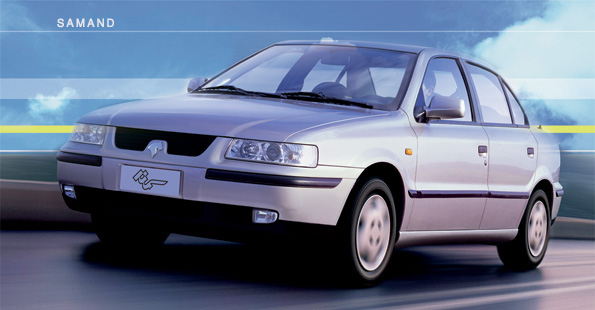
BBC Persian service has reported an increase in automobile prices in Iran. I have checked the dailies such as Shargh, Sarmayeh and Rooz, I could not find similar reports, so following speculation is challengeable by contradicting evidence
In following an import substitution strategy and to boost national pride Iran has established domestic manufacturing lines to assemble automobile. Iran National Automobile Manufacturing Group known as Iran Khodro is the largest of these companies. There are also other firms such as SAIPA, started as a Renault manufacturer and others. Seeking to establish a self sufficient car manufacturing industry Iranian government banned importing foreign made cars for almost a decade; even now tariffs to import foreign manufactured cars are staggering.
In this monopoly situation purchasing a car became a rather difficult process. Queues were made of customers and the right to purchase a care at factory price became a market commodity as well. Interestingly an active market for used cars was developed as well, however hardly one can notice a depreciation of nominal price for cars during last decades. Although this increasing trend was contributed to the inflation and general increase in price index, one should notice demand for cars in Iran was not and is not purely based on utility maximization behavior.
The very low gas prices in Iran and ingenuity of local mechanics[1] keep the maintenance cost of automobile relatively low. On the other hand the real value of money keeps declining because of ever present inflationary conditions. In the absence of higher than zero real interest rates from banking system, households save in any form of durable products available to them: hard currency, golden coins[2], real estate and cars. One also must mention the increasing role of Stock Exchange Market an increase in household savings in the form of bonds and shares; however that has proved a risky endeavor in the long run[3].
It could be argued that Iranian household has learned to diversify its saving portfolio in order to reduce its risk. It also could be argued that demand for cars also is determined by the risk factor.
According to BBC the price of Samand a domestic product has increased from 10’800’000 Tomans[4] to 11’800’000, Price of Peugeot Pars from 16’900’000 to 17’800’000 Tomans. The increase in the case of Peugeot 206 is 400’000 Tomans for its different types. The price of Pride, the most popular car in country, has increased from 6’850’000 Tomans to 7’150’000 Tomans. These show an increase of 4% to almost 10% for the price of different makes and models in market.
Some speculate that the increase in automobile prices is initiated by decrease in the quantity supplied, which is because of lack of parts and Iran Khodro exports. However if the increase is universal for all models and makes, one might conclude that the increase in automobile prices could be caused by a shift in the demand.
It is certain now that government would not implement rationing of car gases to reduce the fuel imports. Thus might demand has increased because of cost of maintenance has remained low. However I would like to argue that the gas price would not be lower than before and the contribution of this policy to increase in demand should not be exaggerated.
The question is that if market demand for cars has increased because of decrease in rate of returns of stocks and an increase in the risk factors? A few months ago there was an increase in the price of gold in the market, which was controlled by increase in the supply of gold by the Central Bank of Iran. Could this be the second wave of increase of demand to save in the form of durable products excited by an increased risk factor and public expectation of a higher inflation rate?
Coming months would answer that.
[1] They actually fix the parts instead of ordering a substitute, thus one pays for labor and not the part.
[2] Traditionally Iranians are fond of golden coins and up to day it is a measurement of value, a memorable gift and a way of saving. As a gift it is more of a gift card whose real purchasing power
[3] The reaction of Tehran Stock Exchange to the last year presidential election results in major losses by middle class shareholders.
[4] Currently 1 USD is 920 Tomans in Tehran’s Bazaar, however one might argue that an exchange rate based on Purchasing Power Parity should be implemented. Thus I keep the prices at local level.
Subscribe to:
Posts (Atom)